Traditional Chinese medicine (TCM) and Acupuncture as it is taught in Australia has 3 theoretical foundations which govern its practice in the modern day. There are many theories which are based on centuries of observation of natural phenomenon.
- Yin-Yang (Taiji) theory
- The 5 elements (Wu Xing)
- The three treasures (San Bao)- Jing Qi Shen
In reality, these theories are actually very simple but deeply profound.
1. Yin-Yang (Taiji) theory
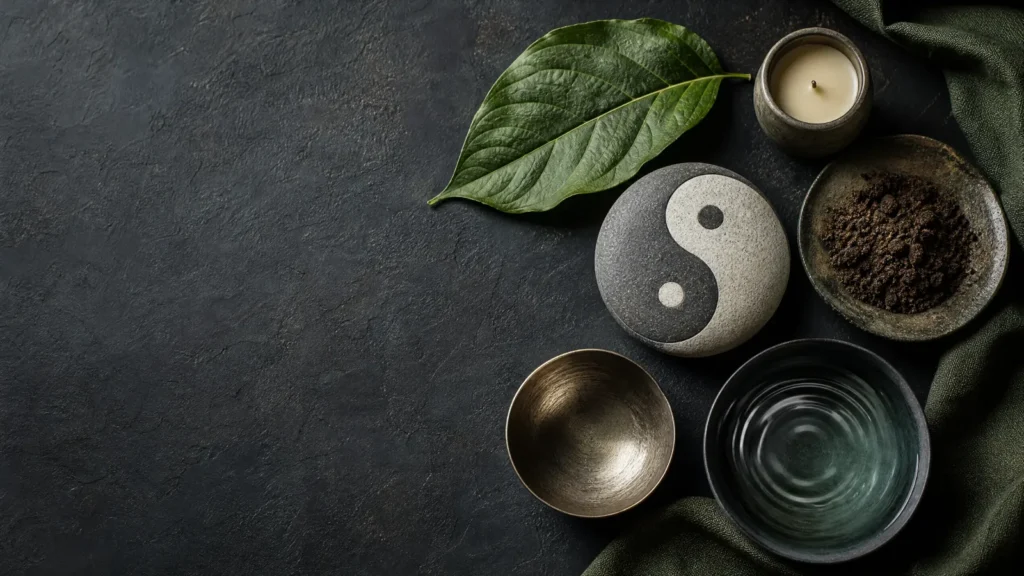
Yin-Yang theory is one that we are all familiar with in the West. The duality of the world- Yin and Yang reflect opposites- day and night, hot and cold, internal and external. These have relationship to processes in the body.
Yang energy (Qi) flows up bringing clarity of thought, too much Yang energy moving upwards is believed in TCM understanding to cause problems (hot flushes, erratic thinking, headaches etc).
Yin energy flows down – too much Yin energy is believed to cause issues (fluid retention, poor cognition, loose stools etc.). This is one of the ways that TCM thinks of illness and disease, through imbalance of Yin and Yang.
The key concept and takeway with Yin and Yang is to remain in balance and harmony.
2. The 5 elements (Wu Xing)
The 5 elements have key relationships with organs and the internal-external environment. The Chinese 5 elements (Wood, Fire, Earth, Metal and Water) is different to the Tibetan/Indian-Ayurvedic 5 elements but still hold significant similarities in theory and application.
2 things to keep in mind:
- The elements bear relationships across many areas- with internal organ pairs, colours, senses, seasons and sounds. For example: The liver organ is connected to- the gallbladder pair, blue-green colour, shouting sound, vision sense, Spring season etc.
- These elements interact with eachother in what is known as the creation (shen) and overacting (ko) cycle- for example Wood/Liver overacts Earth/Digestion. When we feel anxious or stressed this can cause our bowels to become loose- what is known as Wood/Liver/Nervous system attacking Earth/Spleen/Digestive system.
Like with Yin-Yang theory we want to maintain harmony in the 5 elements for optimal health and wellbeing.
3. The 3 treasures (San Bao)
The third concept is what is known as San Bao or the 3 treasures. The premise of the San Bao in medicine is that issues can exist on 3 levels- Jing (Physical), Qi (Functional) and Shen (Mental/Spiritual) levels.
It is important to treat at the level of the issue- for example a musculoskeletal issue such as lower back pain could be defined as a Jing/Physical issue, a Qi/Functional issue could be Irritable Bowel Syndrome (IBS) and a Shen/Mental issue could be anxiety or depression.
The key with the San Bao- like Yin-Yang and the 5 elements is we want to maintain balance between these 3 levels- our body’s structure, function and our mental health.
If you would like to find out more or are dealing with a health issue and would like some treatment- send Ahil an email at ahilnaturopath@gmail.com or call the clinic on (02) 9341 5775.
Ahil Ganesan offers acupuncture, Chinese herbal medicine, naturopathy, cupping, gua sha and moxibustion at Project Dao in Alexandria, near Redfern station.
This article is general information only and is not a substitute for individual advice from a qualified health practitioner. If you have a health concern, please see your GP or book a consultation.