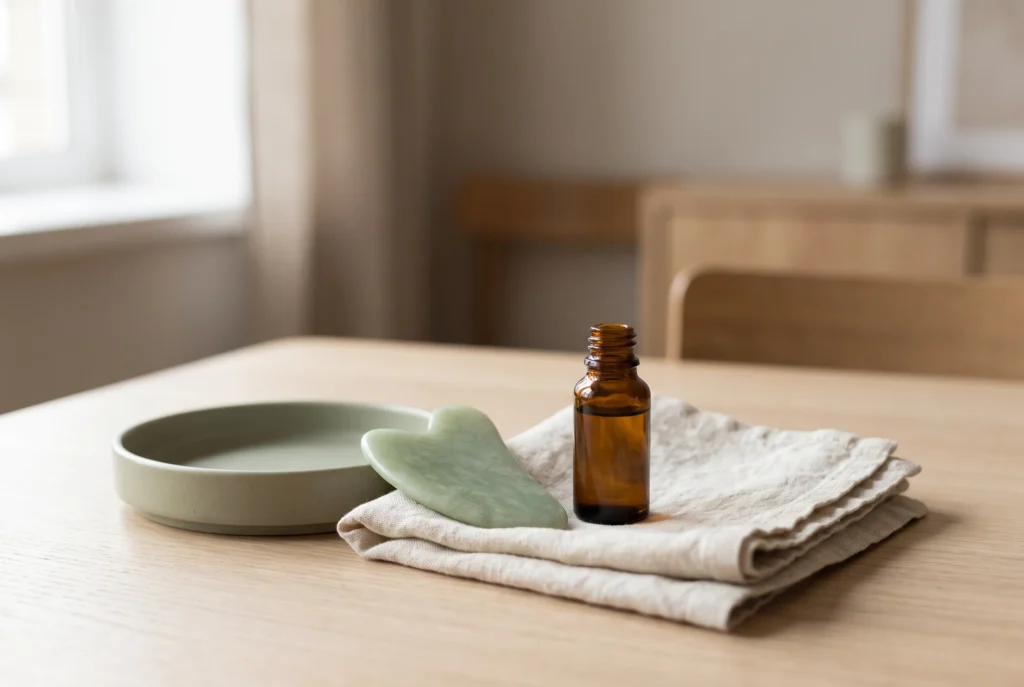
If you have a smooth stone tool sitting next to your moisturiser, you already own a gua sha tool. What you do not own is the treatment I do in clinic under the same name. The two share a word and a shape, and very little else. Facial gua sha is a light cosmetic routine. Clinical gua sha is a firm, deliberate technique over oiled skin on the neck, shoulders and back, and it is meant to leave a mark.
I am not here to talk anyone out of their morning routine. I do want to clear up what happens when the words “gua sha” appear on a clinic price list, because people sometimes arrive expecting one thing and find another.
What “gua sha” actually means
Gua sha is a Chinese term. “Gua” means to scrape or rub, and “sha” is the name for the red or purple speckling that rises on the skin when the technique is done with intent. The tool can be anything with a smooth edge: jade, horn, a ceramic spoon, even a coin. The technique has been practised across East and South East Asia for centuries, at home and in clinics, long before anyone sold a rose quartz version online.
So the name describes the action, not the goal. That is why two people can both say “I do gua sha” and mean completely different things.
Facial gua sha: the bathroom version
The routine most people know from social media goes something like this:
- a cool stone tool, usually jade or quartz
- a few drops of oil or serum on the face
- slow, light strokes along the jaw, cheeks and brow
- a few minutes, most mornings or evenings
The pressure is gentle. It is closer to a light massage than anything else, and that is the point. No sha is raised, and no redness is meant to remain once you finish. It sits within a skincare routine, alongside cleansing and sunscreen, and people describe it as a calm way to start the day.
I have no cosmetic claims to make about it. It is not something I offer, and its purpose is different from mine. If you enjoy it, there is no reason to stop.
Clinical gua sha: what happens at the clinic
When I do gua sha, the setting is usually an acupuncture appointment, and the area is almost never the face. I work on the back of the neck, the tops of the shoulders and the upper back, over a layer of oil so the tool glides rather than drags.
The strokes are firm, repeated and in one direction. Within a minute or two, sha begins to appear: a scatter of small red or purple dots, sometimes joining into a patch. This is the intended result, not a side effect. In Chinese medicine theory, raising sha is understood as moving something that has become stuck near the surface, and the colour and pattern of the marks are part of what I observe.
The marks are not painful afterwards. They fade over one to seven days, a little like a cupping mark, and many people say the area feels warmer while they fade.
Traditionally, this kind of gua sha is used in two situations: tight, congested muscle across the neck and shoulders, and the very first signs of a cold, when the back of the neck feels stiff and chilled. From a Chinese medicine perspective, both are seen as something caught at the surface that the scraping is meant to release. I explain the traditional reasoning in more detail in my comparison of cupping, gua sha and moxibustion.
Same word, three differences
If you take one thing from this post, take these three points:
- Intent. Facial gua sha is a cosmetic routine. Clinical gua sha is part of a Chinese medicine treatment plan, chosen after I have talked with you and assessed the area.
- Pressure. Facial strokes are feather-light and leave nothing behind. Clinical strokes are firm enough to raise sha on purpose.
- Meaning of the mark. In the bathroom, redness means you pressed too hard. In the clinic, sha is the signal I am looking for.
There is also a difference in who is doing it. A cosmetic routine is yours to do as you like. Clinical gua sha involves judgement about where, how firmly and whether at all: thin or fragile skin, a recent injury, certain medications and a few other situations change my approach or rule it out for that day.
Can you do the clinical version at home?
Yes, in a modest way, and I have written a step-by-step guide to gua sha scraping at home for the first signs of a cold. It uses a spoon or coin, olive oil and ten minutes on the neck and shoulders. It is the home cousin of what I do, with less pressure and less coverage, and it suits mild, recent stiffness in someone who is otherwise well.
What it cannot do is assess you. In the clinic, gua sha is rarely the whole appointment. It usually sits alongside acupuncture, sometimes cupping, and always a conversation about why the neck is tight in the first place: desk hours, sleep position, stress, or the first chill of the season. If you are curious about how gua sha fits into a session, the service page covers what to expect and what it costs.
Ready to book?
If you would like to experience clinical gua sha, or simply talk through whether it suits you, you can book online or call me at the clinic on (02) 9341 5775. Appointments are available on Monday, Wednesday and Friday until 8pm and on Saturdays, and no referral is needed.
Ahil Naturopath/Acupuncture is a clinic located near Redfern, Alexandria and Waterloo. We also service areas across Sydney including Botany, Camperdown, Darlinghurst, Erskineville, Eveleigh, Mascot, Newtown, Rosebery, Surry Hills and Zetland.
We offer Acupuncture, Naturopathy, Herbal medicine, Traditional Chinese Medicine (TCM), Cupping, Gua Sha (Scraping) and Moxibustion services in South-East, Eastern and Inner City of Sydney.
This article is general information only and is not a substitute for individual advice from a qualified health practitioner. If you have a health concern, please see your GP or book a consultation.