

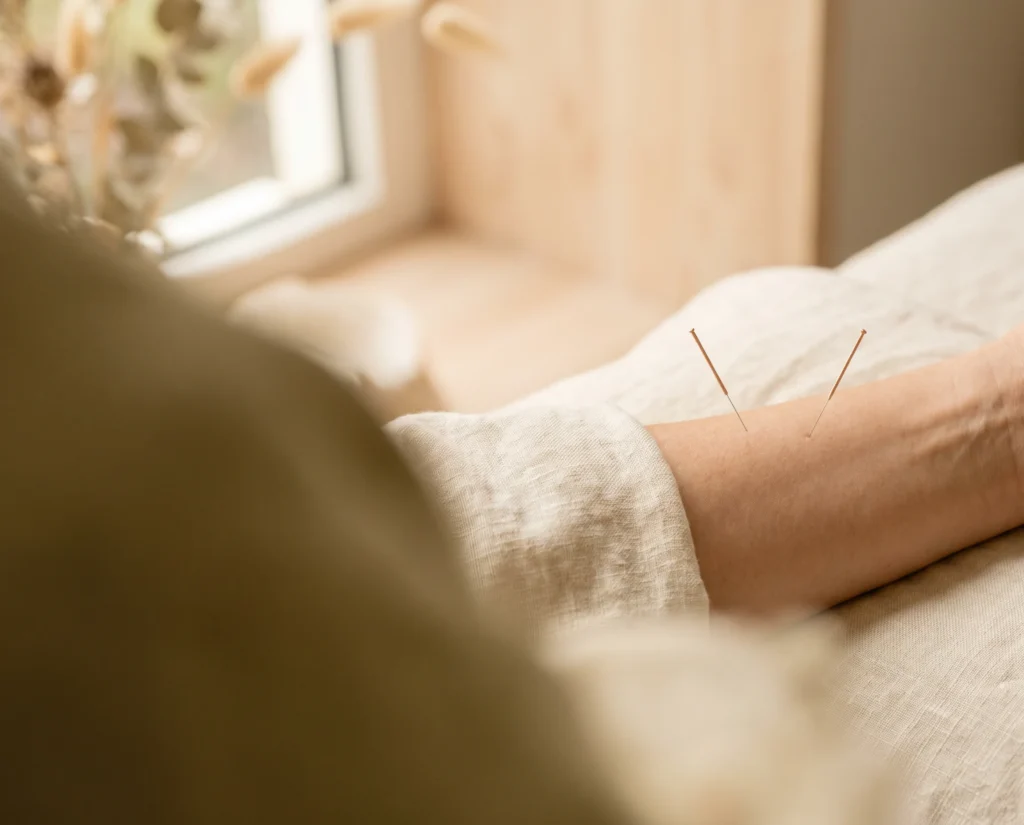
Usually very little, and it is nothing like an injection. Most people feel a brief prick as the needle goes in, sometimes nothing at all, and then a dull, heavy or warm feeling around the point that settles within a few seconds.
That is the short answer I give when someone rings the clinic before their first visit. The longer answer, which is what this post is about, is that the sensations of acupuncture are their own thing, and once you know what to expect most of the worry goes. This post stays on sensation. If you want the full walkthrough of a first visit, from the conversation to the treatment and afterwards, read my post on what to expect at your first acupuncture appointment.
Why it feels nothing like an injection
The needle people picture when they hear the word is the hypodermic needle used for injections and blood tests. That needle is hollow, because it has to carry fluid, and it is comparatively wide with a bevelled cutting tip.
An acupuncture needle is solid, single-use and sterile, and it is about the width of a thick hair. Several of them would fit inside the bore of a hypodermic. It does not cut; it parts the tissue. That is the main reason the two experiences are so different. There is no fluid going in, nothing being drawn out, and the needle is so fine that the skin often does not register it at all.
The needles used for acupuncture at my clinic in Alexandria stay in place for around 20 to 30 minutes. Once they are in, most people stop noticing them.
The sensations that are normal
Chinese medicine has a name for the feeling that arrives once a needle is in place: de qi, usually translated as “the arrival of Qi”. Qi (pronounced “chee”) is the term Chinese medicine theory uses for the body’s functional energy, the activity that moves through the channels acupuncture works with. Whatever you make of the theory, the sensation itself is very consistent, and people describe it in the same handful of words:
- Dull, like a mild ache that is not quite pain.
- Heavy, as if the area has a small weight resting on it.
- Warm, or occasionally cool.
- Spreading, moving a short way along the limb from the point.
- Tingling, or a brief buzz.
From a Chinese medicine perspective these sensations are a sign the point has been reached, so I am looking for them rather than trying to avoid them. They are not sharp. If you feel something sharp, hot or electric, that is different, and I want to know about it straight away.
Some areas are more sensitive than others
Not every point feels the same. The hands, feet and face have more nerve endings close to the surface, so needles there are more noticeable than needles in the back, legs or abdomen. Points near the fingertips and toes are the ones people tend to notice most.
I adjust for this. In sensitive areas I use finer and shorter needles, insert more shallowly, and work quickly so the moment of insertion is brief. Where a sensitive point is not essential to the treatment, I will often choose an alternative. I tell you before each needle goes in, and if a point is likely to be one of the sharper ones I say so.
If something is uncomfortable, say so
The single most useful thing you can do during a treatment is speak up. A needle that is more uncomfortable than the dull, heavy feeling described above can be adjusted in a moment: lifted slightly, turned, or taken out and placed elsewhere. Nothing about the treatment depends on you putting up with it.
The same goes for anything else in the room. If you are cold, if the position is awkward, if you would like the lights lower or would rather talk than lie quietly, tell me. I stay nearby throughout and check in with you while the needles are in.
After the needles come out
Once the needles are removed, some people notice a faint echo of the sensation at one or two points for around 20 minutes. It fades on its own.
Small localised bruises are infrequent. Because the needle is so fine it usually passes between the tiny blood vessels under the skin, but now and then it will catch one and leave a mark the size of a fingertip. It fades like any small bruise. If you bruise easily or take medication that affects bleeding, mention it at the start and I will take that into account.
Nervous first-timers are welcome
A good share of the people who come to me for the first time are nervous about the needles, and some have put off booking for years because of it. That is fine, and you do not need to pretend otherwise. Tell me at the start. In my experience, once the first point has been needled with care, most people realise it was nowhere near as bad as they had imagined, and we go at your pace from there.
Many people tell me afterwards that the anticipation was worse than any needle. More questions about what a treatment involves are answered on the frequently asked questions page.
Ready to book?
If you would like to try acupuncture at the clinic in Alexandria, you can book online or call (02) 9341 5775. Mention that it is your first time and I will take it slowly.
Ahil Ganesan offers acupuncture, Chinese herbal medicine, naturopathy, cupping, gua sha and moxibustion at Project Dao in Alexandria, near Redfern station.
This article is general information only and is not a substitute for individual advice from a qualified health practitioner. If you have a health concern, please see your GP or book a consultation.