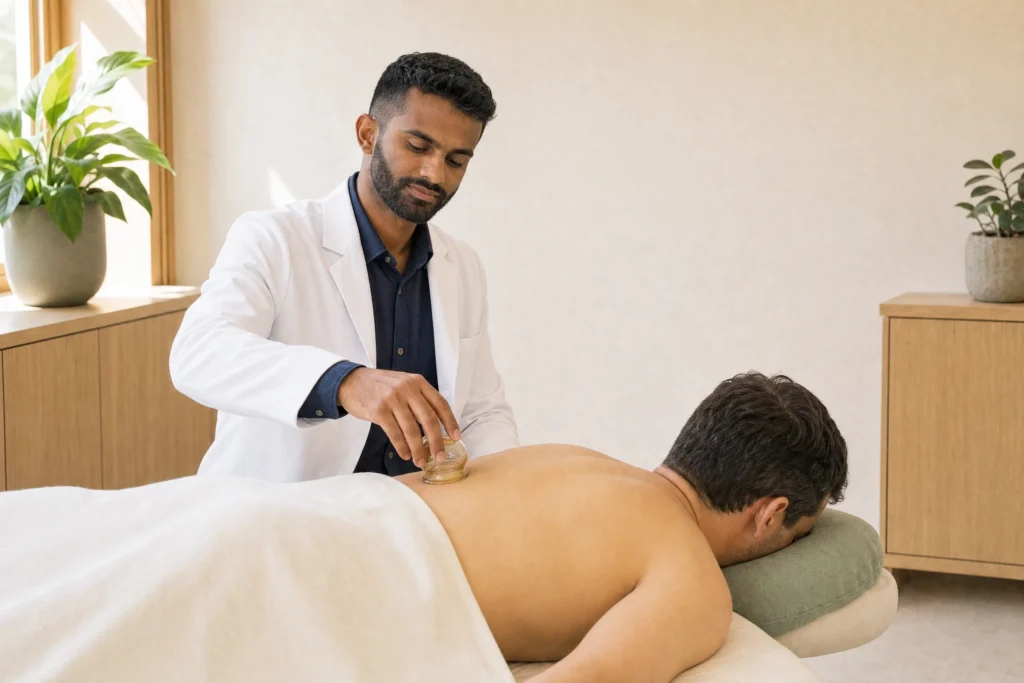
If you spend your days at a screen, the upper back and shoulders are where the day tends to settle, and they are also the part of the body cupping is most often used on. In Chinese medicine theory, cupping is traditionally used where muscle is tight and congested, and it may assist in the management of tension-related discomfort in that area.
That is the careful version, and it is the honest one. Cupping does not undo a desk job. It is one tool, used within an acupuncture appointment, that suits the upper back well for reasons I will explain. Alongside it sit the habits that do the slow, unglamorous work between visits.
Why the desk loads the upper back
I have written about the mechanics elsewhere, so I will keep it short here. When the screen is low and the mouse is far away, the head drifts forward and the shoulders round. The muscles across the top of the back and the back of the neck are then held in a long, low-level effort for hours at a time, which is a different kind of load from lifting something heavy once. The post on desk work and neck pain goes through screen height, chair, habits and the early signs worth noticing.
The other piece is what I call the cascade: the observation that where it hurts is often not where the problem started. A tight neck can be the first link in a chain that runs through the shoulder, upper arm, elbow and wrist. I have described the pattern in the link between where it hurts and where the pain starts. For a desk worker, the practical point is that the upper back and neck are usually the place to look first, whatever is complaining further down.
What cupping is traditionally used for
Cupping uses cups placed on the skin with the air inside partly removed, so the skin and the tissue beneath lift gently into the cup. From a Chinese medicine perspective, the aim is to move what has become stuck. The tradition talks about moving Qi (the body’s functional energy, in Chinese medicine theory) and blood in an area that has become congested. In plainer language, the cups draw on a region of tight muscle rather than pressing into it, which is the opposite direction to most massage. That is the traditional reasoning for reaching for cups when a muscle feels bound rather than strained.
None of this is stated as medical fact. It is the framework I work within, and it is why the upper back, with its broad flat muscles and long-held tension, is such a natural place for cups to go.
Sliding cups and stationary cups
There are two ways I use cups on the upper back, and the region suits both.
- Stationary cupping. Several cups are placed and left in position for a few minutes. This is what most people picture, and it is what produces the well-known round marks. It suits specific spots: the top of the shoulder, the band between the shoulder blades, a particular knot.
- Sliding cupping. The skin is oiled, a single cup is applied, and it is moved slowly along the muscle while still attached. This covers a broad area in one pass, follows the direction of the muscle, and leaves a diffuse flush rather than distinct circles.
The upper back is flat and wide, which is why it takes both well. Many appointments use a slide over the whole region first and a few stationary cups on the spots that stand out. The marks from either fade within about a week. What they are, and why they vary in colour, is covered in what is cupping therapy and those round marks.
How cupping sits within an acupuncture appointment
Cupping usually sits within a 60-minute acupuncture appointment (a standalone cupping session is available if you ask), and whether it is used at all is decided in the room, after we have talked and I have felt the area. Some visits are all needles. Some add a few minutes of cupping before or after. Some, when the upper back is clearly the story, give the cups a larger share of the time. Cupping can be quick and it can be broad, and it leaves time for needling the neck and the rest of the chain.
On expectations, I am careful, because this is where people are promised things. What I can say is that the cups are on for minutes rather than the whole session, that the marks are painless and fade, and that most people describe the sensation as a firm pull rather than anything sharp. How you feel afterwards, and how long that lasts, varies from person to person, and I would be wary of anyone who tells you otherwise. We agree a small number of visits, review, and adjust.
Habits that matter between visits
Cupping happens for a few minutes every week or two. The desk happens for eight hours a day. So the habits matter more than the cups.
- Raise the screen so the top of it is at eye level.
- Bring the mouse and keyboard close, so the elbows stay by your sides.
- Stand and move every 30 to 45 minutes, even for a minute.
- Keep the neck warm in cold weather and away from air conditioning draughts.
- Notice the early signs, the ones the desk-work post describes, and act on them before they settle in.
None of these is dramatic. They are what makes the work in the clinic hold.
Ready to book?
If your shoulders and upper back are carrying the week, book an acupuncture appointment through the online booking page or call (02) 9341 5775, and mention that you would like to discuss cupping. Wear a loose top.
Ahil Naturopath/Acupuncture is a clinic located near Redfern, Alexandria and Waterloo. We also service areas across Sydney including Botany, Camperdown, Darlinghurst, Erskineville, Eveleigh, Mascot, Newtown, Rosebery, Surry Hills and Zetland.
We offer Acupuncture, Naturopathy, Herbal medicine, Traditional Chinese Medicine (TCM), Cupping, Gua Sha (Scraping) and Moxibustion services in South-East, Eastern and Inner City of Sydney.
This article is general information only and is not a substitute for individual advice from a qualified health practitioner. If you have a health concern, please see your GP or book a consultation.