Moxibustion smells herbal and smoky, somewhere between sage, incense and a campfire that has just been lit. Some people find it comforting, some barely notice it, and some notice it on their jumper for the rest of the day. If you have been thinking about booking and the smell is the thing holding you back, this post is for you.
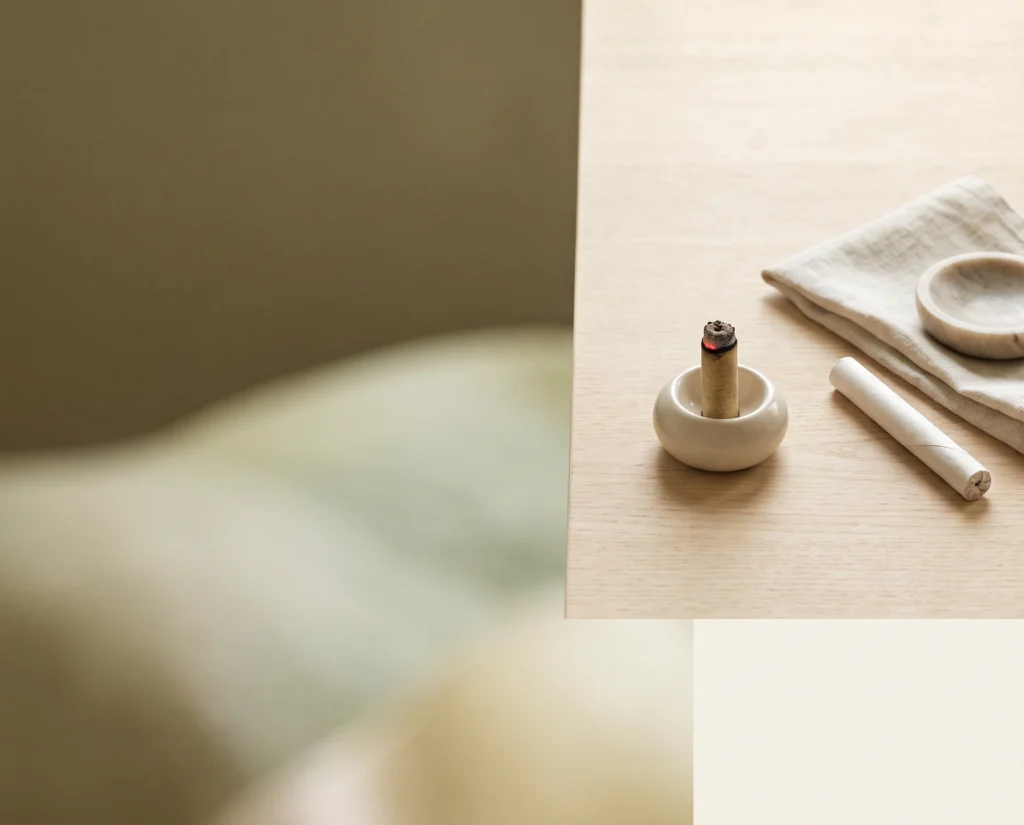
Moxibustion, or “moxa” for short, is the burning of dried mugwort near the skin to warm a specific point. It has been used alongside acupuncture in Chinese medicine for a very long time. At the clinic I use it within an acupuncture session when the traditional picture calls for warmth, and I explain the reasoning on the moxibustion service page. Here I want to answer the three questions people ask before they book: the smell, the feeling, and whether it suits them.
The smell, honestly
Mugwort is an aromatic herb from the Artemisia family, the same group as wormwood, and when it smoulders the scent is unmistakable. People describe it to me as:
- “like a temple”
- “like sage smudging”
- “like the good kind of bonfire”
- “like my grandmother’s kitchen”
Whether it lingers on clothing depends on how much moxa is used and how long you are in the room. A short application on one or two points leaves very little. A longer session, or one over a broad area, may leave a faint scent on the top you were wearing. If that matters for where you are going afterwards, bring a change of top, or tell me and I will keep the session short.
Smoke and ventilation at the clinic
In the clinic I usually use smokeless moxa, made from carbonised mugwort, which gives off far less smoke and scent than a traditional stick, and the treatment rooms are ventilated by an extractor.
My guide to moxibustion at home is blunt about the traditional stick: it makes a lot of smoke, so open a window. Your lounge room does not have an extractor, which is one reason people prefer to try it here first.
What it feels like
Warm. That is the whole answer, and it is the part most people are relieved to hear. The moxa never touches your skin. I hold a lit stick a few centimetres above the point, or place a small cone on an insulating base, and the sensation builds slowly from nothing, to pleasantly warm, to warm enough that you would like it moved. At that moment I move it. Then it comes back, and we repeat.
I stay beside you the whole time. This is not something I light and leave. You say “warm” when it reaches that point, and I lift the stick away. Done this way it does not burn or sting, and it leaves no mark. Many people describe the warmth as spreading a little wider than the spot itself, and some say the area still feels warm on the way home.
Moxa sits within an appointment rather than replacing it. Where cupping and gua sha work the surface, moxa works with warmth, and I have compared the three in a separate post on cupping, gua sha and moxibustion.
Who it may not suit
Moxa is gentle, but it is heat and smoke, and it is not the right choice for everyone on every day. Please tell me before we start if any of these apply, so we can decide together:
- you are sensitive to smoke or strong scents, or find that they bring on coughing or a headache
- you have asthma or any respiratory sensitivity
- your skin reacts strongly to heat, or you have reduced sensation in the area we would be warming
- a doctor has advised you to avoid heat therapy, saunas or hot packs for any reason
- you would rather not have the area uncovered, or you are wearing clothing that cannot be moved aside
None of these is an automatic no. Some mean a shorter application or a different point. Some mean we skip it that day and use acupuncture alone. The decision is yours and mine together, and there is always another option in the room.
What to wear
Moxa is most often applied below the knee, on the lower abdomen or on the lower back, so clothing you can roll up or move aside is ideal: loose trousers, a top that lifts easily, or layers you can take off. Gowns and towels are available if you would rather. If the smell on clothes is a concern, a light layer you can remove and carry is the simplest answer.
The FAQs cover the general questions about first visits, fees and rebates, and the moxibustion page explains what a session costs and how it fits with acupuncture.
Ready to book?
If you would like to try moxibustion, or ask about it before you decide, you can book online or call me on (02) 9341 5775. Mention any sensitivity to smoke or scent when you book and I will plan around it.
Ahil Naturopath/Acupuncture is a clinic located near Redfern, Alexandria and Waterloo. We also service areas across Sydney including Botany, Camperdown, Darlinghurst, Erskineville, Eveleigh, Mascot, Newtown, Rosebery, Surry Hills and Zetland.
We offer Acupuncture, Naturopathy, Herbal medicine, Traditional Chinese Medicine (TCM), Cupping, Gua Sha (Scraping) and Moxibustion services in South-East, Eastern and Inner City of Sydney.
This article is general information only and is not a substitute for individual advice from a qualified health practitioner. If you have a health concern, please see your GP or book a consultation.