
After cupping, keep the area covered and warm, drink some water, and take it easy for the rest of the day. Gentle movement is fine; hard training is better left until tomorrow. That is most of it, but the details are worth knowing before you come in, so here they are.
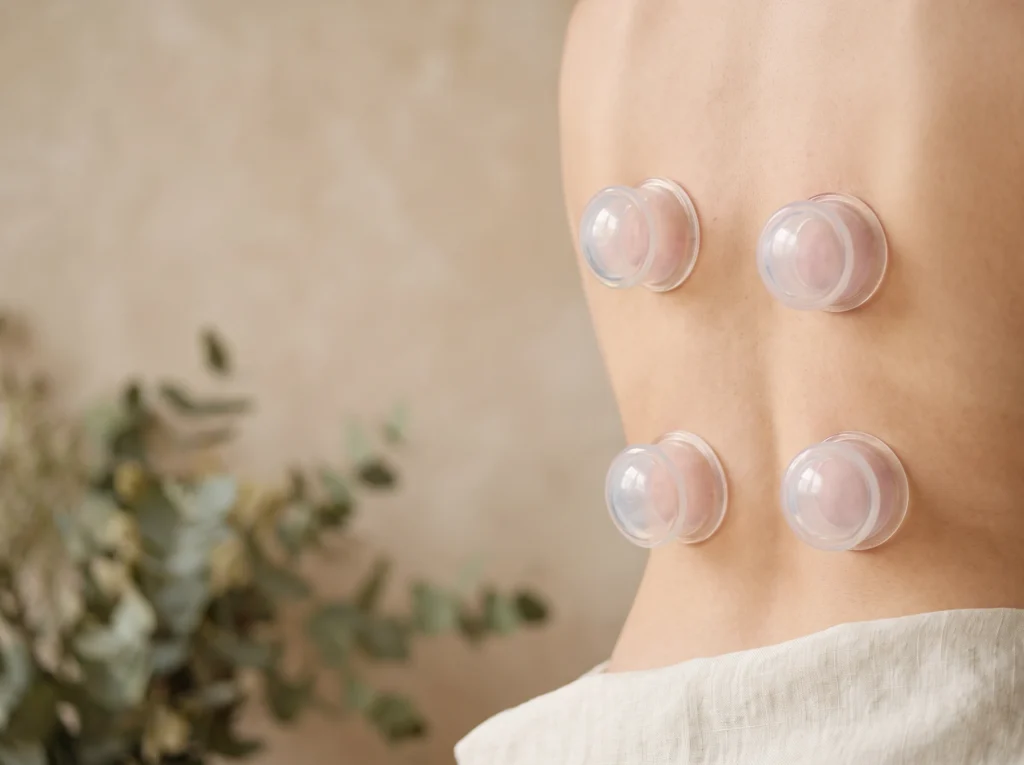
Cupping at my clinic usually happens within an acupuncture appointment, though a standalone cupping session is available if you ask when you book, and the cups mostly go on the back and shoulders. If you want to know what cupping is and why the marks look the way they do, I have covered that in what is cupping therapy and those round marks. This post is about what happens once you leave the room.
What to wear to the appointment
The simplest advice is a loose top that is easy to lift or take off. Cups need bare skin, and because they most often sit across the upper back and shoulders, you will be lying face down or sitting forward with your back uncovered.
- A loose T-shirt or a button-up shirt works well.
- A singlet under a jumper is ideal in winter, because you can put the jumper straight back on afterwards.
- Avoid tight lycra, a one-piece dress or anything with a high, close-fitting neck. They make it awkward to get to the area.
- If the cups may go on the legs or hips, wear or bring shorts.
If you have come straight from work in something impractical, do not worry. There is a towel and a sheet, and I have worked around every kind of outfit.
The rest of the day
From a Chinese medicine perspective, a freshly cupped area is thought to be more open than usual, and the aim for the rest of the day is to keep cold and wind away from it while it settles. In plain terms:
- Keep it covered and warm. Put your top back on before you leave, and a layer over that if it is cool outside.
- Avoid cold draughts. Sit away from the air conditioning vent. Wind on a bare, freshly cupped back is the one thing I would go out of my way to avoid.
- Drink water. Nothing heroic, just a glass or two more than you would otherwise.
- Skip swimming for the day. Pool and ocean water are cold, and the area is best left alone.
- Keep showers warm rather than very hot for the rest of the day, and keep them short.
- Rest if you feel like it. Some people tell me they feel a little tired afterwards. That passes.
Exercise and the 48 hours after
Gentle movement is fine straight away. Walking, stretching, the ordinary business of the day: none of it needs to change. What I suggest leaving for a day is hard training, especially anything that loads the cupped area heavily, such as heavy lifting, rowing, swimming laps or a long run with a pack. The area is easier to reassess at your next visit if it has been left to settle.
By 48 hours, most people have forgotten about the cupping altogether apart from the marks. If you have a session with a trainer or a physio in that window, let them know you have had cupping so they can see the marks for what they are.
The marks
The marks are painless. They look dramatic and feel like nothing. They range from pink to deep red or purple depending on the person and the area, and they fade over about a week, with three to seven days being typical. You cannot speed this up, and you do not need to.
If you would rather not explain them, wear a collar for a few days. If you are happy to, the shortest honest answer to a curious colleague is “cupping, it does not hurt, they fade in a week”. Most people have seen the marks on athletes and are simply curious.
When to call the clinic
Cupping is a low-drama therapy, and aftercare problems are infrequent. Even so, please ring or email if any of the following happen.
- A mark blisters or the skin breaks.
- A mark is painful, rather than tender, or becomes more painful over time.
- The area is hot, swollen or spreading in redness.
- Anything about the area worries you and you would like it looked at.
None of these means something has gone badly wrong, but they are the things I want to know about. The FAQs page has a short answer on the marks, and the contact page has every way to reach me. If you feel unwell in a way that seems unrelated to the skin, see your GP.
Ready to book?
Cupping is usually part of an acupuncture appointment, or can be booked on its own by phone. Book through the online booking page or call (02) 9341 5775, and wear something loose on the day.
Ahil Naturopath/Acupuncture is a clinic located near Redfern, Alexandria and Waterloo. We also service areas across Sydney including Botany, Camperdown, Darlinghurst, Erskineville, Eveleigh, Mascot, Newtown, Rosebery, Surry Hills and Zetland.
We offer Acupuncture, Naturopathy, Herbal medicine, Traditional Chinese Medicine (TCM), Cupping, Gua Sha (Scraping) and Moxibustion services in South-East, Eastern and Inner City of Sydney.
This article is general information only and is not a substitute for individual advice from a qualified health practitioner. If you have a health concern, please see your GP or book a consultation.